



 By Lou Farrell


Revolutionized is reader-supported. When you buy through links on our site, we may earn an affiliate commision. Learn more here.
The Nile cuts a green ribbon through the desert beyond the Cupola window, its banks tracing a path toward the Mediterranean. An astronaut taking a quiet pause aboard the International Space Station (ISS) can follow that familiar geography from a new vantage point.
Then a task calls them back inside, where even the simplest movement follows different rules. Here, professional life happens nowhere near a commute or solid ground.
An astronaut opens tired eyes without feeling a mattress pressing against their back or feet settling onto a floor. In microgravity, a gentle push starts the movement toward another shift.
Beyond the station, sunlight arrives and vanishes repeatedly during the crew’s waking hours. Those recurring sunrises and sunsets offer little guidance for organizing work, so astronauts follow a planned schedule to keep their day on track.
Before hands-on activities begin, the crew checks assignments and connects with flight controllers for an initial briefing. Teams compare priorities, clarify instructions and discuss changes, bringing people aboard and on the ground into the same conversation.
An experiment may involve specialists who remain far below, making coordination across that distance part of the job. Once preparations finish, the astronaut pushes toward the first routine task.
Astronauts wash using a cloth and specialized cleansers. Limited water supplies demand conservation, and microgravity prevents liquid from draining downward, making controlled application essential.
Hair gets a similar treatment with no-rinse shampoo, which astronauts work through before drying with a towel. The product requires only a small amount of moisture, conserving the supply needed for other purposes aboard.
Getting dressed involves a different kind of compromise because it remains impossible to wash clothes aboard the ISS using the available facilities. Crew members wear garments until they need replacing, then discard them.
Those worn items join the station’s waste, which eventually burns up during atmospheric reentry. Even the end of a shirt’s useful life follows a different path in orbit.
Long before reaching orbit, astronauts spend years preparing to live and work far from home. The station has sustained more than two decades of continuous presence, depending on people who can solve problems together and meet demanding individual standards.
Entry requirements for the United States astronaut program illustrate the starting point, although partner agencies set their own criteria:
Selection leads to further learning about station systems, emergency responses and teamwork. Rehearsing difficult situations gives candidates opportunities to build practical skills before they must use them in orbit. A colleague’s knowledge may matter as much as their own when a problem calls for several people to work together.
Candidates also practice operating robotic equipment and preparing for spacewalks, both of which require precise coordination.
Astronaut Cady Coleman spent roughly six months aboard the station during a mission in 2010-2011. Over that period, the ISS became the place where ordinary life unfolded.
Once aboard, astronauts trade training scenarios for experiments that depend on conditions ground-based laboratories can reproduce only briefly or approximately, including sustained microgravity. The station’s continuous orbital free fall gives scientists time to observe processes that short tests on Earth cannot fully capture.
During her ISS stay, astronaut Loral O’Hara worked on three-dimensional printing of heart tissue in microgravity. Cells must retain useful structures, and the station offers a valuable setting for examining how that organization develops.
Astronauts prepare equipment and follow procedures closely so researchers can interpret the observations with greater confidence. Having people beside an experiment also allows adjustments and troubleshooting as the work unfolds. Flight controllers and investigators can guide those steps from Earth, but the person aboard handles the equipment directly.
Station maintenance shares the schedule with those procedures, so an astronaut may move from scientific equipment to repairs within the same shift. Keeping systems working protects the laboratory and everyone living inside it.
Experiments may continue across crew changes, with observations from successive missions contributing to a longer record. All of this takes place inside a workplace, moving around the planet beneath it.
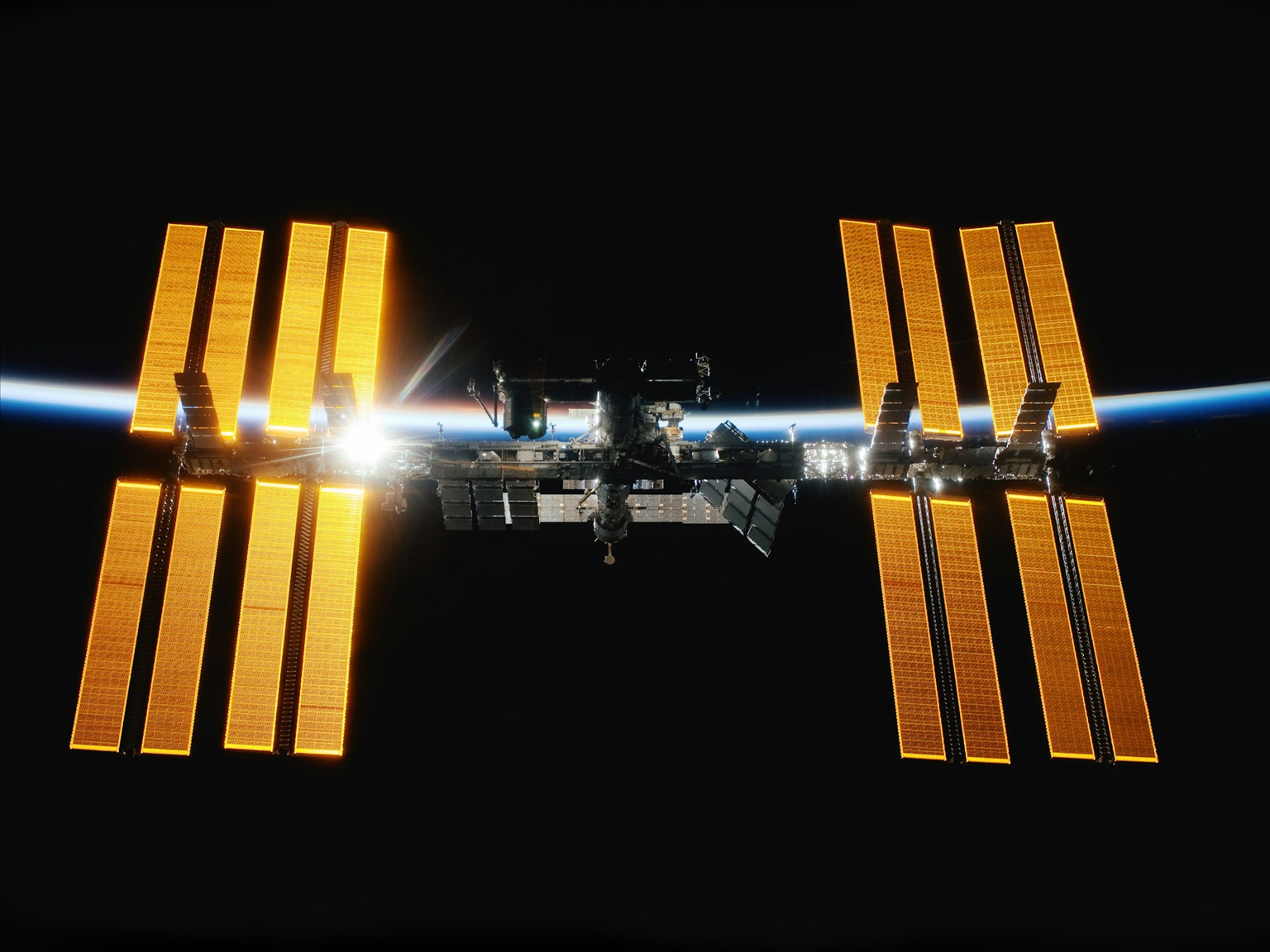
The ISS travels at approximately 17,500 mph and orbits Earth every 90 minutes, carrying its crew through repeated passages of daylight and darkness. Gravity pulls it inward as its forward motion carries it along a curved path around the planet.
That shared free fall explains why astronauts and unsecured objects float inside. The force still acts on the structure, but everything aboard follows the same trajectory, creating the weightless conditions in which the crew works.
From Earth, the laboratory can appear as a luminous point moving steadily across the sky, visible to the naked eye. Favorable passes around dusk or dawn let reflected sunlight reveal it against a darker background, sometimes with brightness comparable to Venus.
By lunchtime, a break calls for some unfamiliar coordination. Food and drinks stay in enclosed containers to keep bites and droplets under control.
Despite those practical limits, the standard menu offers a pantry stocked with 200 items, including food and beverages. Crew members choose from that shelf-stable supply to suit their individual preferences.
Preparation might involve adding water to a packaged dinner or warming it before opening. The process differs from cooking in a kitchen, but deciding what to eat remains a recognizable part of the day.
A shared conversation can make the occasion feel ordinary, giving colleagues a chance to interact beyond the immediate demands of an assignment. Familiar flavors also offer continuity with life below, even when the surroundings look nothing like a dining room.
For people living together over an extended mission, these small domestic moments can give the day a welcome rhythm. Once the meal ends, astronauts secure the remaining supplies and collect the packaging before returning to work elsewhere in the station.
Floating removes much of the effort that standing and walking demand on Earth, so exercise earns its own place in the crew’s schedule. Muscles and bones need deliberate loading, and cardiovascular training helps maintain conditioning.
Resistance equipment, a treadmill and a stationary bicycle provide different ways to exert that effort. Using them consistently helps astronauts address the musculoskeletal and cardiovascular effects of spaceflight during extended ISS stays.
Exercise also helps astronauts prepare for weight-bearing activities again after returning to Earth, where standing and walking require them to support their bodies. The movements that seem effortless at home become something to train for while living in orbit.
Astronauts can also experience reduced white blood cell efficiency during their missions, which helps explain why medical monitoring remains important alongside physical conditioning. Exercise forms one part of the care that supports their health.
Treating these sessions as part of the job gives them dedicated time alongside research and maintenance.
Off-duty hours give astronauts time to pursue their own interests. A conversation with family or a favorite program offers a connection to people and activities that remain far below.
Coleman recalls enjoying solitude after the lights dimmed, saying, “I’d just fly slowly through the station.” The modules that carried a day’s responsibilities also gave her room to simply enjoy being there.
At the Cupola, attention can turn outward again. A coastline passes beneath the windows before darkness gathers over the sea. Beyond the close-up world of equipment and procedures, the view stretches toward the horizon.
Sometimes, looking at Earth offers a private moment within an intensely shared environment.
Interested in exploring this daily routine in-depth? Check out this interactive, text-based adventure, and try your hand at living through a day as an astronaut on the ISS!
Multiple paths from start-to-finish are available, so play around and see how your day pans out!
A day aboard the International Space Station moves from weightless waking through improvised washing, careful research and deliberate exercise. By evening, the same environment that complicates routine tasks offers an extraordinary place to pause.
Making a workable home there means rethinking habits that once required little attention. Beyond the window, the planet that shaped those routines keeps turning.
Revolutionized is reader-supported. When you buy through links on our site, we may earn an affiliate commision. Learn more here.

This site uses Akismet to reduce spam. Learn how your comment data is processed.