




 By Emily Newton


Revolutionized is reader-supported. When you buy through links on our site, we may earn an affiliate commision. Learn more here.
Space is no longer a void to be crossed but a contested domain where strategic positioning matters as much as technological capability. As nations push beyond low Earth orbit into cislunar space, control over logistics infrastructure will define geopolitical power as decisively as the Strait of Hormuz or Suez Canal.

Operating in cislunar space demands supply chains capable of spanning 238,855 miles with no ground infrastructure, no atmospheric braking and limited launch windows dictated by orbital mechanics. Cargo must traverse radiation-heavy zones, survive months-long transits and arrive with precise timing to support crews dependent on external resupply.
Every kilogram launched from Earth costs thousands of dollars, making efficiency a strategic imperative. Unlike terrestrial logistics, where delays mean inconvenience, missed transfer windows in space can strand hardware in unrecoverable orbits or leave crew stations without life support reserves.
Current launch cadences cannot sustain the sortie rates required for permanent lunar operations, while the infrastructure to refuel spacecraft in orbit, transfer cargo between vehicles and preposition supplies at waypoints does not yet exist at scale.
A recent launch from Iran demonstrated refined orbital maneuvering during satellite deployment, showing progress in propulsion and guidance systems essential to space logistics. The same technologies that enable precise orbital insertion also power long-range ballistic systems, raising dual-use concerns in a region marked by geopolitical tension.
States facing international isolation have often avoided space investments during military conflicts to prevent signaling weapons development to neighbors. Iran’s push into space transport systems despite sanctions and regional instability suggests it values demonstrating technological capability over diplomatic restraint.
Restartable engines, precision attitude control and multi-burn sequencing are foundational for any nation seeking cislunar access. But when states under U.N. Security Council scrutiny for nuclear proliferation develop these systems, the overlap between space commerce and nonproliferation complicates international cooperation on shared logistics standards.

NASA’s Artemis program has faced repeated delays, pushing crewed lunar landings beyond 2027 and creating an opening for competitors to build logistics infrastructure. China has committed to collaborating with Russia to establish a research station on the lunar surface by the mid-2030s, supported by cargo and crew missions that will test supply chain endurance in ways the U.S. has not yet attempted.
The nation that demonstrates reliable cargo delivery to the lunar surface first will set the standards others must follow or work around. Early infrastructure — landing pads, fuel depots, cargo transfer systems — becomes the default architecture that shapes whether other nations can plug into the network or remain isolated.
Delay compounds strategic risk. If competing powers create functioning logistics networks while U.S. systems remain in development, American influence over how cislunar resources are governed diminishes, and the standards for international cooperation may reflect priorities incompatible with open-access.
Lunar orbit positions offer gravitationally efficient staging points where spacecraft can refuel, transfer cargo and adjust trajectories without the energy cost of returning to Earth. NASA’s Gateway station, designed to operate in a near-rectilinear halo orbit, will combine U.S. technology with contributions from international partners, creating a logistics node dependent on multilateral resupply coordination.
Gravitationally stable L1 and L2 points hold positions relative to Earth and the Moon, enabling consistent communication with both surfaces and serving as transfer hubs for cargo moving between cislunar zones. Control over these positions translates to influence over traffic flow, as any nation operating a refueling depot or cargo waypoint at L1 or L2 can monitor, assist or restrict access to vessels transiting the Earth-Moon corridor.
Orbital real estate is finite. The most fuel-efficient parking orbits and the communication-optimized Lagrange positions will fill as infrastructure expands, creating competition for slots that offer operational advantages and the ability to observe or obstruct rival logistics movements.
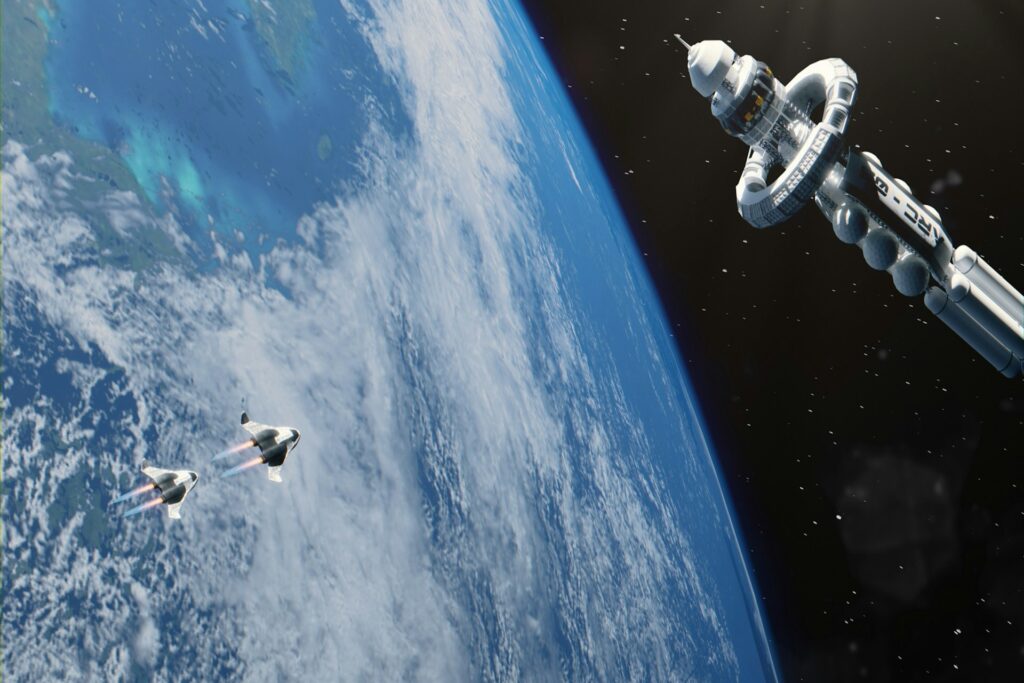
Transporting finished components from Earth to cislunar space imposes mass penalties that make large-scale construction prohibitively expensive. Technologies enabling in-space servicing, assembly and manufacturing aim to produce structural elements, refine propellant and repair spacecraft on-orbit, reducing dependence on terrestrial supply chains and enabling missions Earth-based logistics cannot sustain.
Nations that master on-orbit manufacturing can operate with smaller launch footprints, extending mission durations and expanding operational reach without proportional increases in Earth-to-orbit cargo mass. Mastering on-orbit manufacturing shifts strategic advantage toward those with advanced robotics, autonomous fabrication systems and the industrial base to prototype hardware in microgravity.
The ability to process lunar regolith into construction material, extract oxygen for life support or produce fuel from water ice transforms the Moon from a destination into a logistics hub. Early movers in resource processing will define the technical standards for extraction and on-orbit manufacturing, influencing whether these capabilities remain open-access or become proprietary systems controlled by a narrow set of state and commercial actors.
Space logistics cannot function in an environment cluttered with debris from failed missions, spent rocket stages and collision fragments. Spacecraft equipped with active debris removal technologies designed to capture and deorbit hazardous objects can also approach, grapple and maneuver functioning satellites, raising concerns about dual-use applications in contested orbital regimes.
A spacecraft capable of removing debris can disable or relocate an adversary’s logistics asset, inspect a competitor’s cargo vehicle, or alter the trajectory of a rival’s refueling depot. The same robotic arms and proximity operations needed for debris clearance provide the technical foundation for on-orbit servicing, salvage and, in adversarial scenarios, interference.
International norms governing debris removal remain underdeveloped, and no binding framework distinguishes between legitimate salvage operations and hostile interference with another nation’s space assets. As space logistics expands, the capacity to interact with uncrewed cargo vehicles and orbital infrastructure will become both an operational necessity and a potential source of strategic friction.
The strategic future of space logistics hinges on unresolved questions of legal authority, operational resilience and technical control.
Ambiguities in the Outer Space Treaty of 1967 create uncertainty about whether a nation operating a fuel depot at L2 or a cargo hub in lunar orbit exercises de facto control that is incompatible with the treaty’s prohibition on national appropriation of celestial bodies. No enforcement mechanism exists to adjudicate disputes over orbital slot allocation or access to refueling infrastructure in cislunar space.
A catastrophic failure at a critical refueling depot or cargo transfer station could strand missions and disrupt the orbital traffic patterns required for sustained lunar operations. Off-world supply chains operate with minimal redundancy, making single points of failure existentially threatening to dependent missions.
The entities that define technical standards for docking mechanisms, refueling connectors and communication systems will shape which missions can interoperate and which remain isolated. If competing powers develop incompatible logistics architectures, cislunar space could fragment into separate operational spheres, making cooperation strategically untenable.
Infrastructure choices made in the next decade will shape the balance of power in space for generations. Without international coordination on shared standards and governance frameworks, strategic competition for logistics dominance risks fragmenting cislunar space into contested zones where rival powers operate incompatible systems.
Revolutionized is reader-supported. When you buy through links on our site, we may earn an affiliate commision. Learn more here.

This site uses Akismet to reduce spam. Learn how your comment data is processed.