




 By Revolutionized Team

Revolutionized is reader-supported. When you buy through links on our site, we may earn an affiliate commision. Learn more here.
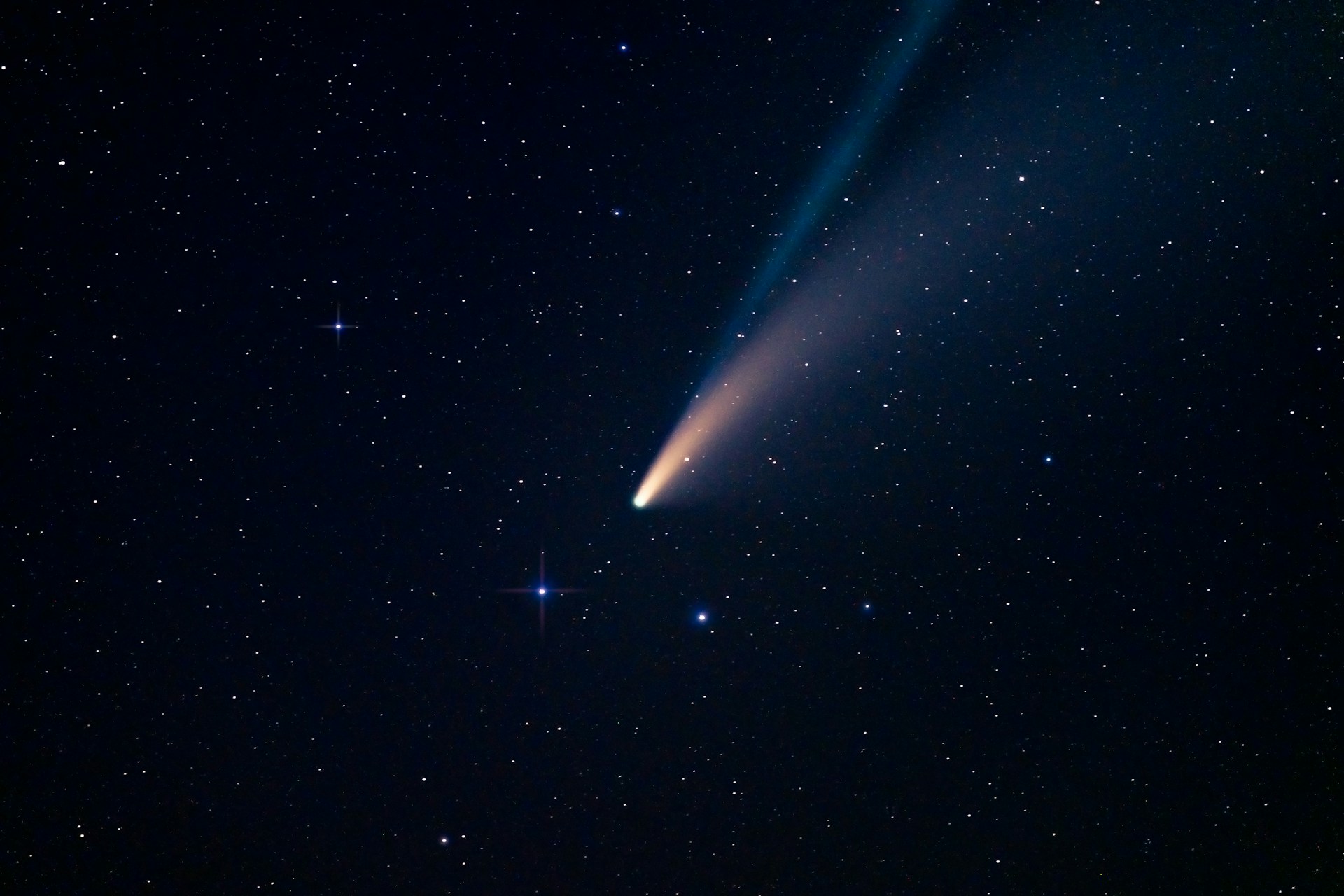
During a nightly survey, the Asteroid Terrestrial-impact Last Alert System (ATLAS) telescope identified something highly unusual—the first interstellar object to enter the Milky Way in nearly a decade. Adding to their fascination, data suggests the interstellar comet 3I/ATLAS could have been formed via a never-before-seen chemical process.
Researchers in the Rio Hurtado Valley of Chile use the NASA-funded ATLAS telescope to detect near-Earth celestial bodies weeks before potential impact. In July 2025, they noticed an object hurtling through space. Its speed and trajectory revealed something exciting—it is not from our solar system.
The first known interstellar object was Oumuamua, which was observed passing through our solar system in 2017. The second was 2I/Borisov, which was discovered in 2019. The third has since been dubbed 3I/ATLAS, named after the telescope that first identified it.
It has a solid, frozen core made of dust, carbon dioxide (CO2) and water rather than rock and metal. Its coma—a bright trail of dust and gas escaping the nucleus—provides further evidence that it is a comet, not an asteroid. This makes it the second comet to enter our solar system, as Oumuamua displayed asteroid-like characteristics.
The interstellar comet 3I/ATLAS was formed in a faraway star system and somehow ejected into interstellar space, a low-density region between stars within a galaxy. This is how, despite its large size, it has not collided with anything for billions of years. It spans hundreds of meters to several kilometers across, according to the European Space Agency.
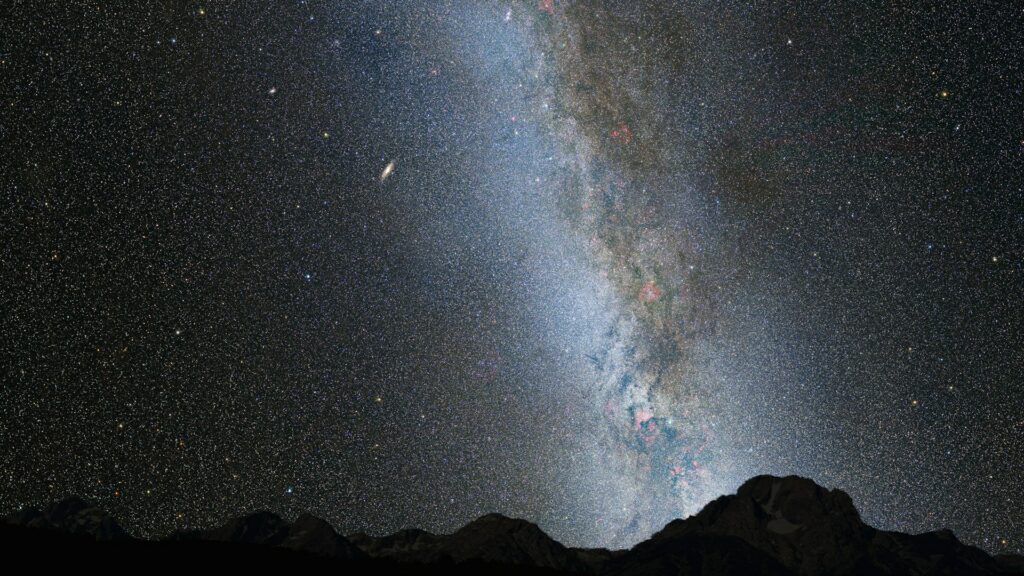
It approached from the general direction of the center of the galaxy, which is located within the constellation Sagittarius. This region is massive, dense and chaotic. Since it is hidden by a thick layer of interstellar dust, it is best observed using non-visible light, such as X-ray and infrared.
Astrophysicists believe the interstellar comet could be upward of seven billion years old, as indicated by its incredible speed. In this time, it has likely passed through interstellar clouds and star-forming regions where supernovae are going off and new stars are being born. This incredible variety of environments lends to its uniqueness.
Multiple comets come within viewing distance every year, so why are researchers so interested in 3I/ATLAS? Beyond being one of the few known interstellar objects to pass through the Milky Way, it has several rare qualities indicative of highly unusual origins.
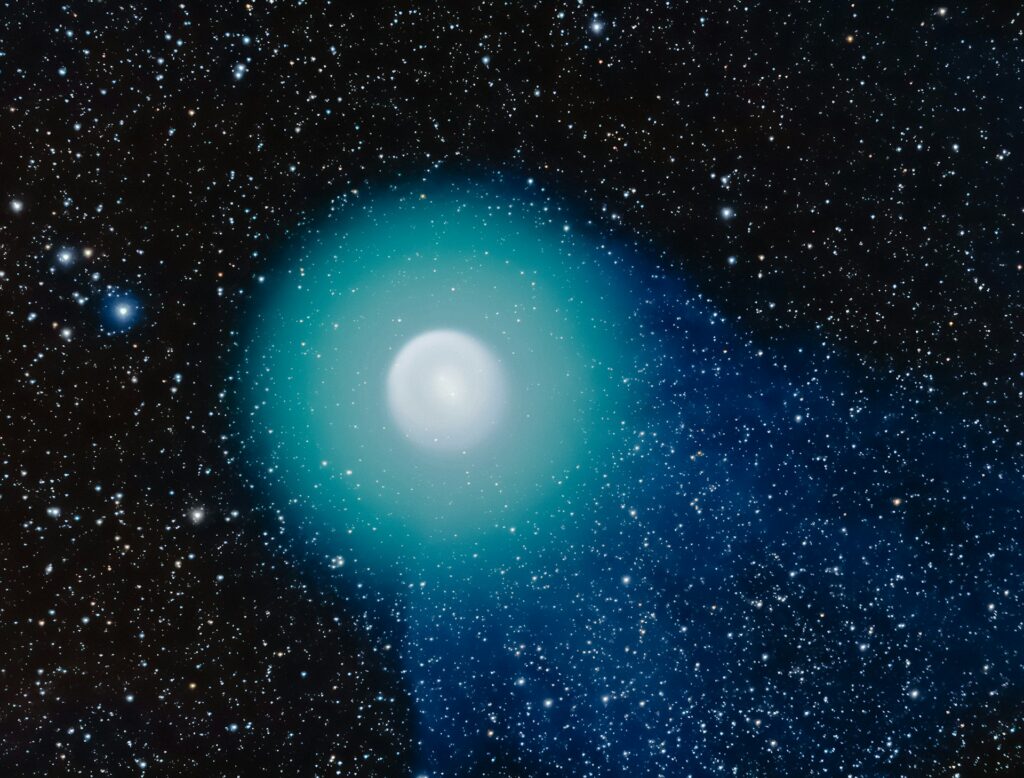
Typically, when comets move closer to the sun, the heat vaporizes the icy nucleus, forming a distinct plume of gas and dust that points sharply away from the sun. Uncharacteristically, 3I/ATLAS’ tail pointed toward the sun—and it was not a matter of perspective.

Astrophysicists expect solar radiation pressure and the solar wind to push gas and dust particles away from the sun, as routinely seen in comets from the Milky Way. However, they are sometimes too heavy to be pushed, so a tail forms that appears to point toward the sun. A sun-facing coma is unusual, but not unprecedented. It happened in 2014 with C/2014 UN271.
Another unique characteristic about this interstellar comet is that it has an atypical composition. The James Webb Space Telescope revealed its coma was dominated by CO2. This is very different from the comets we’re used to, suggesting a unique origin.
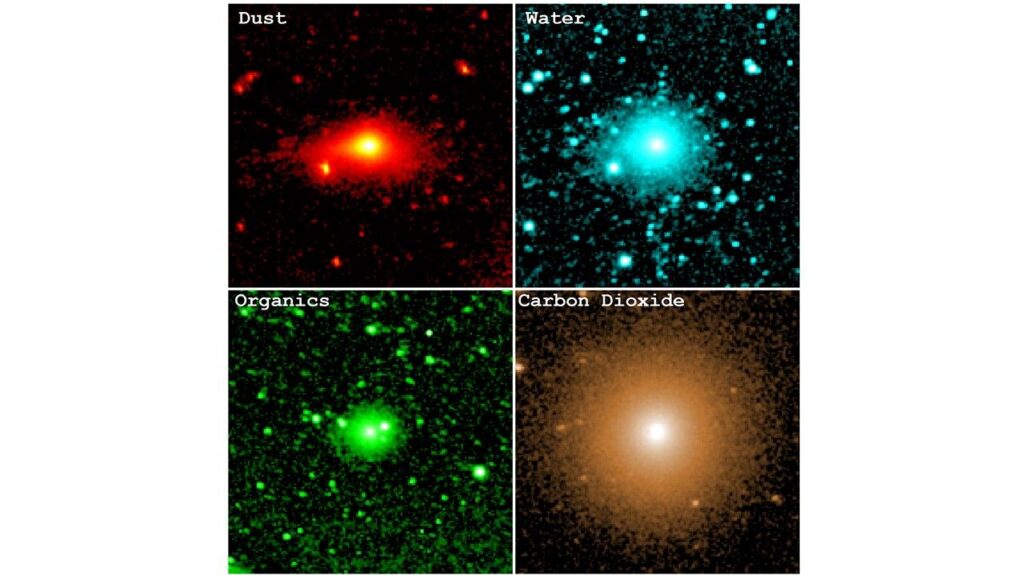
3I/ATLAS may have been formed in a very cold region of its home star system where CO2 was abundant. Alternatively, differences in its ice formation patterns may have prevented the sun’s heat from reaching the water deeper inside the nucleus, so only the surface CO2 turned into gas as it approached the sun.
To say space is colossal is an understatement. It is so large that we have to measure it in astronomical units (AU) or light-years, not kilometers or miles. Interstellar space stars at the boundary of the Oort Cloud—a massive spherical cloud of small icy bodies that make up a shell surrounding the solar system—at about 100,000 AU.
For reference, Proxima Centauri—the closest star to our own—is approximately 269,000 AU away. Despite being our closest interstellar neighbor, an uncrewed spacecraft traveling at 36,000 mph would take an estimated 78,000 years to reach it.
3I/ATLAS is scientifically significant because the differences between it and the celestial bodies from the Milky Way could provide insight into the composition of other solar systems—places humans may never have the technology to reach.
It formed an estimated 7 billion years ago, roughly 7 billion years after the universe was formed in an unimaginably hot, dense explosion. Since the Earth settled into the solar system around 4.5 billion years ago, the interstellar comet is much older. It could tell researchers a lot about the early universe’s chemistry and formation.
The interstellar comet 3I/ATLAS likely escaped from a distant planetary system. Its unusual composition and imbalanced nickel-to-iron ratio suggest it has undergone a never-before-seen chemical process, as these materials typically appear together in relative proportions. Adding that to its anti-tail and high CO2 level, researchers could learn a lot from this icy object.
The significance of a water-rich interstellar comet was not lost on researchers. It helps them understand the necessary ingredients for life. Upon impact, comets bring a large proportion of water to primordial planets. In the future, by tracking its trajectory with advanced technology, they may be able to watch the advent of life on new planets.
Since 3I/ATLAS is an interstellar comet, rumors quickly began circulating about its possible alien origins. We now know for a fact it is not a spaceship. It has been in our solar system long enough for scientists to measure its size, velocity, composition and coma, leaving no room for doubt. However, that makes this discovery no less exciting.
NASA initially delayed the release of high-resolution imagery of 3I/ATLAS, leading some to believe they had confirmed the existence of aliens and were either covering it up or figuring out how to proceed. In reality, the government shutdown prevented them from processing the data.
Capturing imagery of a faraway object traveling at high speeds is difficult, especially when other celestial objects create visual noise. The professionals at NASA have to process, organize, catalog and review photos before releasing them. High-resolution photos accompanied by detailed explanations are now available.
A radio telescope operated by the South African Radio Astronomy Observatory detected radio absorption lines by hydroxyl (OH) radicals. The OH absorption signal was detected in two spectral lines at frequencies of 1.665 and 1.667 gigahertz. This is not proof that the comet was secretly a spacecraft. It’s a natural phenomenon, not a technological one.
3I/ATLAS had an icy nucleus. As it approached the sun, the heat melted the ice, and solar ultraviolet light split the water into hydrogen (H) and OH. The light excited the OH molecules, causing them to emit or absorb radio signals at very specific frequencies. This allowed them to be detected by radio telescopes.
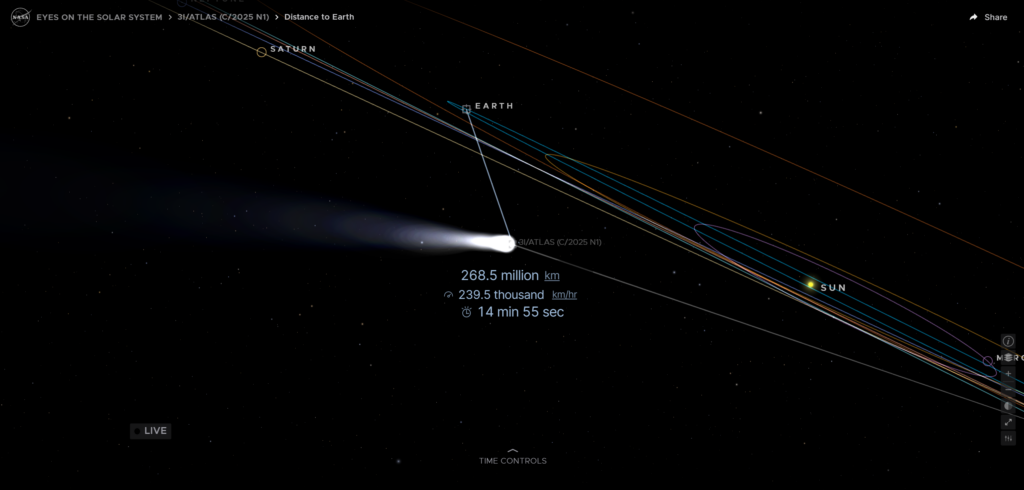
The interstellar comet 3I/ATLAS came from outside our solar system and punched a direct path through, which is unusual. This indicates it was already traveling in a straight line in the vacuum of space before it entered the Milky Way.
It passed Earth 1.798 AU—167.1 million miles—away on December 19, 2025. Its solar conjunction relative to Earth occurred earlier, on October 21, 2025. Its proximity to the sun and Earth allowed scientists around the world to capture high-resolution photos and imagery for a short period.
Will people on Earth be able to see 3I/ATLAS? While it can’t be seen with the naked eye, they can use personal telescopes to watch it as it departs our solar system. It will remain visible until Spring 2026.
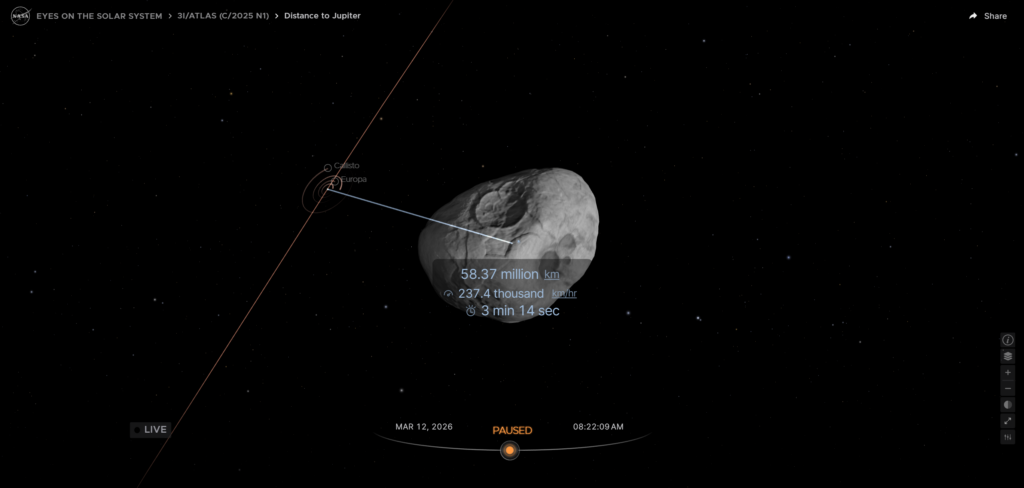
3I/ATLAS came relatively close to Earth, the Sun and Mars. In March 2026, it passed Jupiter. To say it was “close” is relative, as it was approximately 58.37 million kilometers away, according to NASA’s Eyes on the Solar System simulation. There is no chance 3I/ATLAS will collide with Earth or other planets.
It came closest to the sun in October 2025. In the month following, the all-sky hydrogen camera on the Solar and Heliosphere Observatory observed it releasing a huge plume of hydrogen, implying the release of 13.5 million metric tons of water.
3I/ATLAS was traveling at 137,000 mph when it was first discovered. It briefly accelerated to 153,000 mph at its closest approach to the sun. When it leaves, it will be at the same speed it entered. Having traveled through the outer solar system, it heads back into interstellar space. Since it is traveling in a straight line, we will never see it again.
While each rare encounter with interstellar comets is exciting, 3I/ATLAS was particularly fascinating. Even as it departs the Milky Way, scientists continue studying it. Every time a new interstellar object appears, they learn more about distant planetary systems. The larger this dataset grows, the more humanity can learn about the early universe.
Revolutionized is reader-supported. When you buy through links on our site, we may earn an affiliate commision. Learn more here.
This site uses Akismet to reduce spam. Learn how your comment data is processed.